

CARING COMMUNITY IS THE GREATEST AMENITY.
People want more than a place to live. They want a place to thrive. Thriving requires caring community, but that doesn’t happen spontaneously. We’re here to help community along…
If you were a solo ager, family caregiver or worker with a child or disability, which option would you choose?
1.
STANDARD SENIOR COMMUNITY
• Neighbors of similar age and health.
• Bundled versus custom services.
• Subjected to infantilizing treatment.
2.
STANDARD APARTMENT BUILDING
• Surrounded by nameless neighbors.
• Poor community programming.
• Mostly segregated from older adults.
3.
SUPPORTIVE VERTICAL VILLAGE
• Mixed ages contributing together.
• Neighbor-led activities and events.
• Neighbor-made goods and services.
We suspect that you picked option 3, so we’re here to QUICKLY and AFFORDABLY assess the readiness of your multifamily property(s) to help bring a caring community—or vertical village—to life.
REVIEW OUR PROCESS >>>
America is getting sicker and lonelier while trending older. The resulting care demands are great and growing. Generally called a “care crisis,” we call this an opportunity to course correct and unlock new levels of health and well-being. Indeed, the difference between a crisis or an opportunity is a decision.
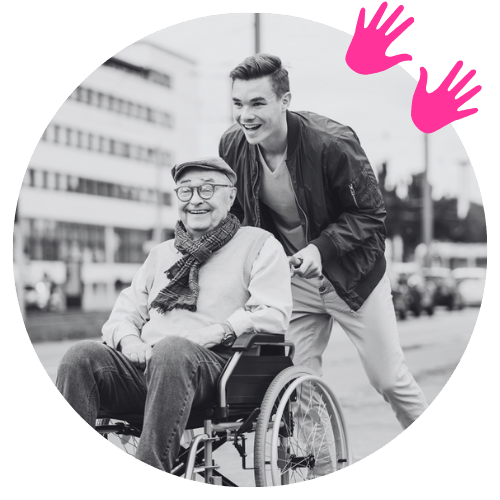
IN TERMS OF CREATING HEALTH—VERSUS TREATING ILLNESS—CARING NEIGHBORS MATTER MORE THAN DOCTORS.
This neighbor power primarily lies in community connectedness and support for individuals.
And this is what could take you to a new level of leadership and success:
Multifamily housing is fertile ground for growing villages.
“This is my home, and I have no intentions of leaving.”
GRACE WHITMIRE
The Overlook at Oxon Run vertical village resident
Multifamily housing is convenient for encouraging community connectedness and support, and tends to be more attainable and accessible to a wider cross section of dwellers than single family homes.
Care benefits help to woo and retain workers.
A village in your property is a care benefit that can help you woo and retain new kinds of renters.
REVIEW OUR PROCESS >>>
Along with getting sicker, lonelier and older, America is getting choosier:
People want to be engaged and have a sense of agency, and have quit workplaces unsupportive of that—think “The Great Resignation.” We sense a similar disruption brewing in the world of unsupportive housing.
Wise employers are offering benefits to help meet workers’ care wants and needs. Not-as-wise housing providers are offering shinier real estate, not understanding that COMMUNITY is the greatest amenity.
“Don’t make things fancy. Make them interesting.”
DR. SARA ZEFF GEBER
Leading authority on solo aging.
Solo agers are adults 55+ living without the support of adult children or other close family. Family caregivers provide support to family—by blood or choice—living with short- or long-term limitations.
Solo agers and family caregivers comprise around 85 million people with vested interests in care networks.
And though we say it takes a village to raise a child, the truth is that we all—ALL—need a village to thrive.
While some folks might want residential villages offering high-end experiences, we’d bet most would prefer modest dwellings and the names of neighbors they could call for help or to connect with to have some fun.

IMAGINE A FUN, TALL COMMUNITY CENTER WHERE PEOPLE LIVE & GET CARE. NOW IMAGINE ALL KINDS OF PEOPLE OF ALL AGES THRIVING THERE.
THAT’S HOW WE IMAGINE A FULLY-FLEDGED VERTICAL VILLAGE.
A vertical village can help to attract and retain engaged residents—and benefit a property’s bottom line as a result—by creating the conditions for the birth of stories that form the most genuine and alluring kind of marketing. Potentially stories about…
• Uniting people.
• Connecting villagers to resources.
• Promoting healthy living.
• Reducing loneliness and social isolation across ages.
• Nurturing youth and helping older adults to live in community.
• Sparking creativity and joy!
• Providing home-based volunteer and business opportunities.
• Providing opportunities to learn and teach skills.
• Resource sharing.
• Creating a culture of care and support networks for caregivers.
• Showing us that we’re all the same and interdependent.
We won’t pretend that creating this reality will happen fast.
It will unfold in stages, but even tiny or basic villages can produce wonderful benefits.
Growing vertical villages will require new thinking and, in the best case, an alliance including neighbors, in-home or neighborhood-based service providers, community builders like us and housing leaders like you.
But let’s not make the best case the enemy of better.
Let’s prepare to grow vertical villages by activating treasures that we have access to now.
“How did a rental community in a competitive market go from stagnating at 65% occupancy at best for years, to 95% occupancy in 18 months? A key ingredient is creating ways for the talents of our residents to be seen.”
ROB LIEBREICH
CEO and President of Goodwin Living.
To be clear, the most valuable village treasures are hidden in plain sight:
Neighbors with abundant gifts of the head, hands and heart.
A vertical village doesn’t happen simply by housing people under one roof. It starts with inviting residents to lead and stepping back.
REVIEW OUR PROCESS >>>
The future of America’s healthcare is in the home.
As a housing provider, you are on the path to becoming a health promoter—by force or choice.
When other housing providers are focused on fancy, now’s the time to stand out from the crowd by choosing to embrace home as a health hub. But this isn’t about choosing sterility. Quite the opposite:
PLAY is a kind of health care for all.
“The opposite of play is not work. It’s depression.”
BRIAN SUTTON-SMITH
Play theorist
Playing—having fun—is one of the healthiest ways that we can spend our time. Rather than fighting disease, we prefer spreading health by helping neighbors to have fun—especially the adults—in ways that they love!
Interested to explore how your property can shine and gain loyalty?
Then consider the possibility of it hosting a caring community.
At $297, the assessment is priced at a fraction of the turnover cost of losing just one tenant for feeling indifferent or displeased about your building.
In a nutshell, we will…

GATHER INFORMATION
We’ll conduct surveys of the property’s residents and management.*

REVIEW THE INFORMATION
We’ll analyze the data to assess your property’s current village readiness.

REPORT THE RESULTS
We’ll give you an easy-to-digest write-up with guidance for next steps.
You will…
MAKE INTRODUCTIONS
You’ll connect us with the appropriate property management person.
GAIN UNDERSTANDING
You’ll review your property’s readiness results and possible next steps.
TAKE ACTION
You’ll improve your property’s village readiness or start the hosting journey.
*The $297 cost is for digital surveys.
An extra cost applies if certain residents will require paper surveys.

MEET YOUR ASSESSOR:
Dr. Mary-Elizabeth Harmon is a longtime village maker, as well as scientist turned storyteller, caregiver and founder of A Village for Life.
A graduate of MIT and The Johns Hopkins School of Medicine, Mary-Elizabeth left the laboratory as a virus researcher and later joined the Office of Inspector General in the U.S. Dept. of Health and Human Services. There, she evaluated programs and wrote data-driven stories (i.e., reports) to make recommendations for their improvement. Her work has been used for Congressional testimonies, and she is a two-time winner of the Inspector General’s Exceptional Achievement Award.
A Michigander raised in Nairobi, Kenya, Mary-Elizabeth has been making informal villages since returning to the U.S. for college. At MIT, she won an award for contributions to extracurricular life on campus. At Hopkins, she won an award for professionalism and community leadership. As a neighbor, Mary-Elizabeth served on the board of the Atlanta Downtown Neighborhood Association and was an active community builder in her former home at the Healey Condominiums. There, she was a dubbed “The Healey Communicator” by the board of directors.
QUESTIONS FOR MARY-ELIZABETH:
Our budget and team are stretched thin. Why should we consider an assessment?
I consider those reasons why it might be wise. Villages are neighbor-led, and can lighten your team’s load by helping with things like hosting events or creating building networks that people turn to for support instead of management. These make a building more attractive to new and existing dwellers alike. The main “asks” from management are use of common spaces and building-wide communication channels.
Can we really expect our residents to do free work on our behalf?
People grow villages to satisfy personal desires, whether to make friends, to give and/or get support or perhaps to showcase their businesses. But the beauty is that by inviting village activity into your property, you are contributing—without your team needing to get too involved—to the birth of stories that form the most genuine and alluring kind of marketing. Indeed, your team being too hands-on could stifle this.
Neighbors as health creators, homes as health hubs and play as medicine. Are these opinions?
Those claims are based on research and government action. 1) There’s a growing body of work showing that social and community factors have a greater impact on health than medical care. 2) In 2024, FDA launched “Home as a Health Care Hub” to further its vision. 3) The National Institute of Play has done and compiled research showing that “play is as important to your mental health as food is to your physical health.”
Are villages something new in the U.S.?
There’s been a “village movement” in the U.S. since 2002, with now hundreds of villages operating or in development. There are also so-called naturally occurring retirement communities, or NORCs, in apartment buildings that support older adults to live in community.* Recognizing this, New York funds state and local NORC programs. Through A Village for Life, I aim to spread mixed-age villages with medical backup.
Let’s say that my property is village ready. What happens next?
The first thing is to celebrate! The next is to decide whether to get village activation support for your residents, if your resources permit. If not, we’re working to offer low-cost ways for your residents to learn and get assistance. Also, our newsletter is free and provides practical ways for neighbors to connect.
Whether you’re interested in an assessment or not, …
We hope that someone from your team will join the Vertical Village Alliance.
*NORCs are “naturally occurring” insofar as a sizeable percentage of older adults naturally live in a building. But connecting the people to each other and to services and supports requires effort.
What Mary-Elizabeth’s neighbors &
fellow caregivers say:
I just want to thank you for being such a good neighbor while we were in the Curve building. I remember you ringing our bell to check on us, bringing us gifts for special occasions and spending time out with us. Bringing your mom downstairs and spending time with us. We love all of that and miss you all. I still have my hidden words book, our puzzle, our board game and the three little hippos from Kenya.
You are truly a kind and generous person.
I love you.
Lena, 7 years old
Mary-Elizabeth’s personalized, professional caregiving advice helped me to improve my loved one’s quality of life at the end of a terminal illness, even at a distance. She is a compassionate expert who offers practical, thoughtful guidance.
Stacie
Thank you for being such a good neighbor, for being so kind, always checking on us, telling us little stories and bringing us gifts. I am happy to have been part of your little friends.
Celia, 11 years old
I met Mary-Elizabeth when my wife and I moved into downtown Atlanta. She was instantly interested and engaged with us. She made our decision feel exciting and justified. Over time, our friendship grew and deepened. I came to realize that what we saw in her welcoming us was her vision for being a good citizen—regardless of location! What leadership!
Matt
Mary Harmon is a very genuine kind hearted woman. She’s very committed, loyal and devoted. Most of all very caring. I can go on about her bold personality. I had a personal trauma happen to me and my family, she opened her arms so easily to try and help calm me as best as she could. She did some tasks for me when I just couldn’t and for that I’m very thankful.
N.B., Hospice nurse
Miss Mary-Elizabeth is not only a neighbor but a good friend as well. She’s kind, trustworthy, thoughtful and goes beyond to make you feel special. It’s the little things like bringing treats for our dog Milo to gifting my son on his birthday and Christmas every year. She makes a bigger impact than she realizes. We love to have Miss Mary as a neighbor and a part in our lives.
Jessica
I enjoy talking to Miss Mary because she always listens to me. We talk about birds and nature. She makes me feel special with the unique gifts she gives me.
Jayden, 10 years old
I remember living in a community where most of the residents were mostly preoccupied by their work. For almost 3 years a single friend I was able to make was a housewife as me with 2 children but one afternoon I had a chance to meet Marie-Elisabeth who was new in the building, she greeted us and introduced herself, we started a little conversation, we spent about 20 minutes chatting. And she will become one of our great friends my children and I, asking if I need help, stopping by to check on us. During the pandemic she texted constantly to ask if I have everything. She will just take a list, shop and drop off.
People like Marie-Elisabeth does exist but they are few in this modern context. I am happy and thankful to her.
Viviane
I am now seven but still remember the first time you meet us out and came to seat with us, we were able to get to know each other at least by name and so by the time we started enjoying seeing you and run to hug and wave hello from our balcony. You brought us present, and cards for Christmas.
We love to see your mom she tells us stories sometimes when she was a teacher.
I want to see you again.
Jules-Martin, 7 years old